Evaluation
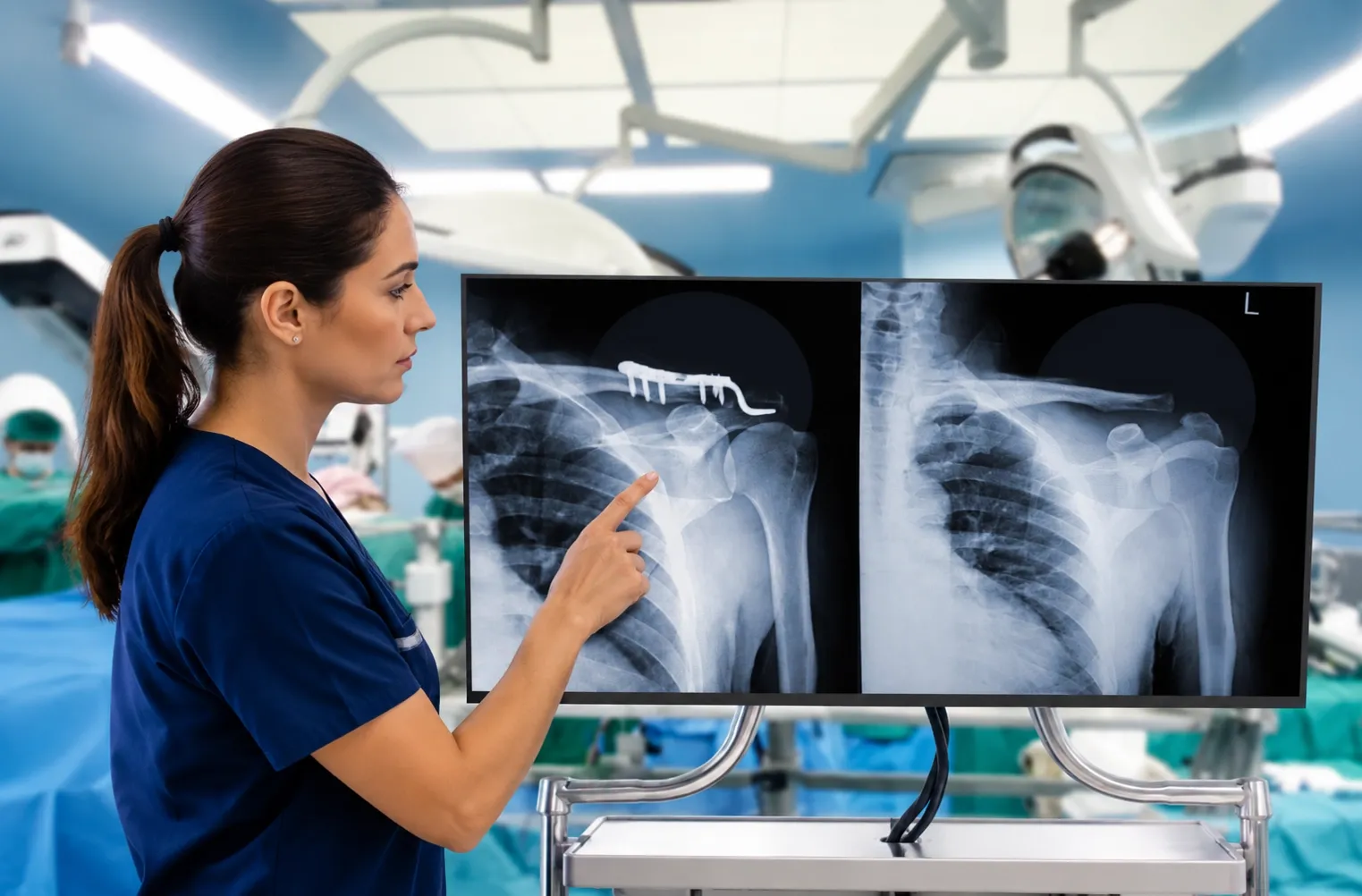
Dr. Leo Chen reviews the on-site digital X-ray and orders CT if the fracture pattern is complex.

Surgical Fracture Repair
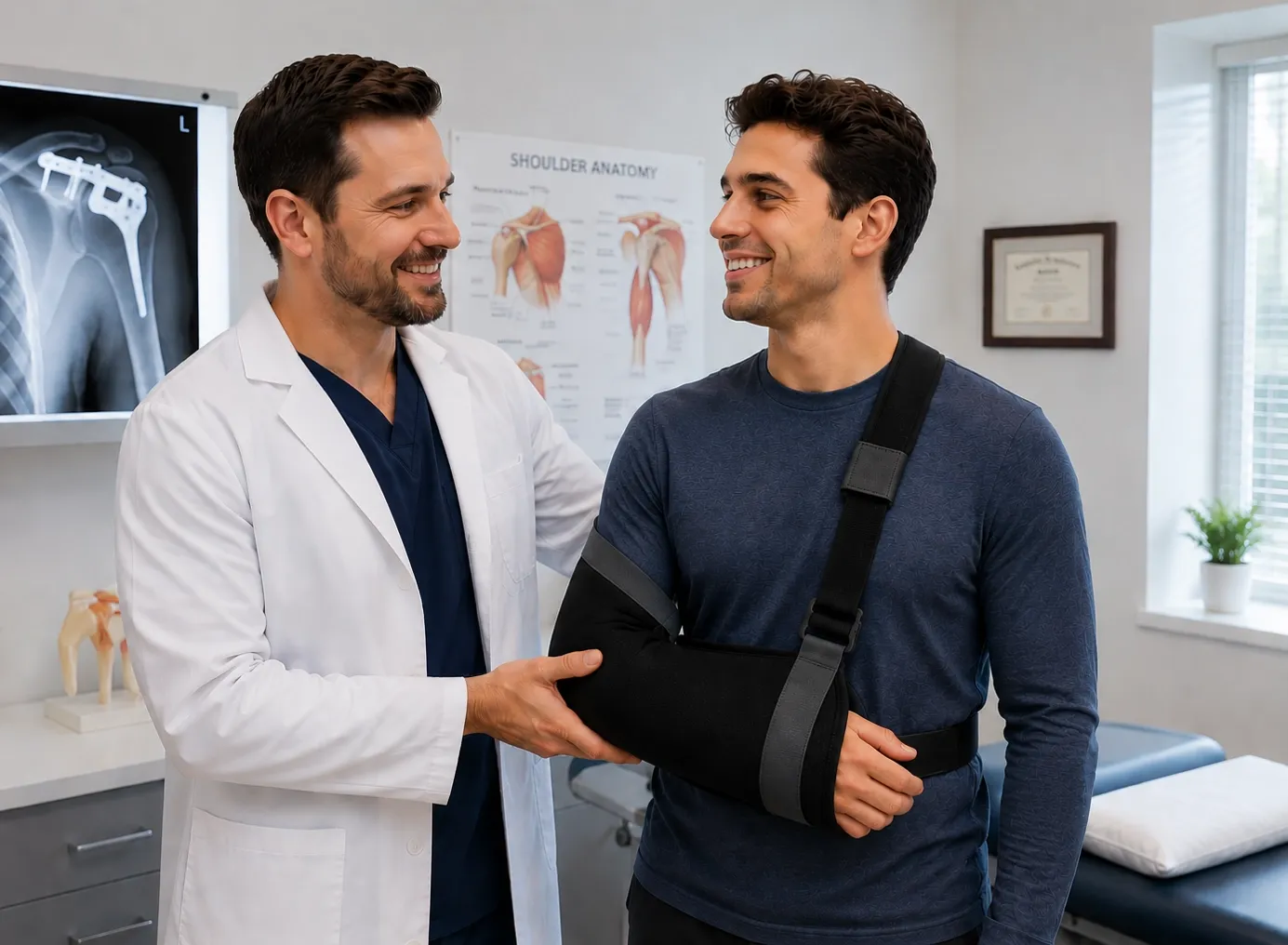
Problem and surgical solution
A broken shoulder rarely happens in isolation. It usually follows a fall onto the outstretched arm, a direct sideline hit, a motorcycle or bicycle crash, or a low-energy fall in someone with weaker bone. Patients arrive with deep, throbbing pain, an arm they cannot lift away from the body, swelling, bruising that travels down the chest wall, and visible deformity over the collarbone or upper arm. Sleep becomes impossible, dressing is one-handed, and even simple driving stops. Without timely evaluation, displaced fragments can heal in the wrong position and limit overhead reach for life.
Broken shoulder surgery restores the normal architecture of the shoulder so the rotator cuff, deltoid and joint capsule can work together again. Depending on the fracture pattern, Dr. Leo Chen uses open reduction and internal fixation (ORIF) with locking plates, intramedullary nailing, or shoulder replacement (hemiarthroplasty or reverse total shoulder) for unreconstructible head fractures. Patients with concurrent soft-tissue injury may also need rotator cuff repair in Fort Walton Beach. The goal is anatomic alignment, stable fixation that tolerates early motion, and a predictable rehab path so patients return to fishing, golf, work and the active Emerald Coast lifestyle.
Fracture fixation and reconstruction
Broken shoulder surgery is a category of orthopedic procedures used to realign and stabilize fractures of the bones that form the shoulder girdle: the proximal humerus (upper arm bone), the clavicle (collarbone) and the scapula (shoulder blade). It is part of the fracture care services offered at Emerald Coast Ortho. The choice of procedure depends on which bone is broken, how many pieces are involved, how displaced the fragments are, the quality of the bone, and the patient's age, activity level and overall health.
For proximal humerus fractures, displaced two-, three- and four-part patterns are commonly treated with open reduction and internal fixation using a precontoured locking plate (proximal humerus locking plate), which holds the tuberosities and head together with multiple fixed-angle screws. Surgical neck fractures in younger patients with good bone may be a candidate for intramedullary nailing (IMN), which passes a titanium rod down the canal through a small incision at the top of the shoulder. When the humeral head is shattered beyond reliable reconstruction, especially in older patients with poor bone, Dr. Leo Chen will recommend hemiarthroplasty (replacement of just the ball) or, more often today, reverse total shoulder arthroplasty, which reverses the ball-and-socket geometry so the deltoid can power the arm even if the rotator cuff is no longer functional.
Clavicle fractures that are displaced more than 2 centimeters, shortened, comminuted (multiple fragments), or associated with skin tenting or neurovascular irritation are typically treated with plate fixation: a low-profile titanium plate is contoured along the superior or anterior surface of the clavicle and locked in place with cortical and locking screws. Scapula fractures are far less common and are reserved for surgery only when there is significant glenoid (socket) displacement, a floating shoulder, or a double disruption of the shoulder suspensory complex.
Not every broken shoulder needs surgery. Many minimally displaced proximal humerus fractures, the majority of midshaft clavicle fractures, and most scapular body fractures heal well in a sling with structured therapy. The art of fracture care is matching the right fracture to the right treatment, and Dr. Leo Chen errs toward non-operative care whenever the radiographs and the patient's goals support it.
Outcomes that matter
2000+ Satisfied patients






Bone fragments are returned to their original alignment for normal motion.
Stable fixation allows therapy to start within weeks, not months.
Reduces the chance of a stiff, weak or deformed shoulder long term.
A defined rehab path with measurable milestones at each visit.
Most patients return to work, fishing and golf within 4 to 6 months.
Stabilizing fragments quiets the mechanical pain of a mobile fracture.
Comparison
| Treatment | Mechanism | Time | Results | Duration | Downtime | Best For |
|---|---|---|---|---|---|---|
| Broken Shoulder Surgery | Plate, nail or replacement to realign and stabilize bone | 1 to 2 hours in OR | Anatomic alignment with early motion | Permanent fixation | Sling 4 to 6 weeks | Displaced, unstable or articular shoulder fractures |
| Slings | Immobilization to allow bone to heal in place | Worn 4 to 6 weeks | Heals in current position | Until clinical and radiographic union | Limited arm use 4 to 6 weeks | Minimally displaced fractures with acceptable alignment |
| Casting | External immobilization for stability | Worn 4 to 8 weeks | Heals in cast position | Until union confirmed on X-ray | Stiffness risk during immobilization | Select pediatric or stable adult fractures |
| Non-Operative Care | Sling plus phased PT and serial imaging | Weekly to monthly visits | Good outcomes in stable patterns | 12 to 16 weeks total program | Activity restriction during healing | Stable fractures and patients not safe for surgery |

Surgical candidacy
The decision to operate is made jointly by Dr. Leo Chen and the patient after reviewing radiographs, CT (when needed) and individual goals. Not every shoulder fracture requires surgery, and not every patient is a surgical candidate.
If you have any uncertainty about whether surgery is right for your fracture, an in-office consultation with same-day digital X-ray will clarify the path forward.
Dr. Leo Chen reviews the on-site digital X-ray and orders CT if the fracture pattern is complex.
Dr. Leo Chen selects ORIF, intramedullary nailing or shoulder arthroplasty based on the pattern and bone quality.
General anesthesia with an interscalene regional block; patient is positioned in beach chair.
Dr. Leo Chen reduces the fragments, places the implant (locking plate, IM nail or prosthesis) and confirms with fluoroscopy.
Sling immobilization, phased physical therapy from week 2 to 6 and serial X-rays through union.
What to know
Broken shoulder surgery is a well-established orthopedic procedure, but like any operation it carries real risks. Dr. Leo Chen reviews them in detail at the pre-operative visit and tailors the risk profile to the specific fracture pattern and patient.
Common, usually self-limited: post-operative pain controlled with multimodal medication, swelling and bruising of the chest wall and arm, temporary numbness from the regional block (resolves in 12 to 24 hours), stiffness during the first weeks of rehab, and surgical-site soreness that improves week over week.
Uncommon: superficial wound infection or delayed union requiring extended sling time, transient axillary or musculocutaneous nerve dysfunction, and adhesive capsulitis (frozen shoulder) requiring extended PT.
Rare but serious: deep infection requiring washout, deep vein thrombosis or pulmonary embolism, nonunion requiring revision surgery, malunion, avascular necrosis of the humeral head (more common after high-energy 4-part fractures), permanent nerve injury.
Any sudden chest pain, shortness of breath, fever, calf pain, drainage from the incision or worsening numbness should prompt a call to (850) 864-3339 or a visit to the emergency department.
Broken shoulder surgery is a medically necessary procedure and is almost always billed through health insurance, Medicare or Tricare. The total cost has several components: the surgeon's professional fee, the facility (hospital or ambulatory surgery center) fee, the anesthesia fee, the implant cost (locking plate, IM nail or prosthesis), follow-up office visits, imaging, and physical therapy.
Because every insurance plan is structured differently, the out-of-pocket portion depends on your deductible, co-insurance percentage, in-network versus out-of-network status and whether you have met your annual maximum. Emerald Coast Sports Medicine and Orthopaedics participates with most major commercial carriers as well as Medicare and Tricare; our team will verify benefits before surgery so you know your estimated responsibility in advance.
What is included at no separate charge during the surgical episode: the pre-operative consultation with Dr. Leo Chen, on-site digital X-rays in our office, in-office dispensing of your post-op sling, the operative procedure itself with surgeon and assistant time, and the standard post-operative visits at 2, 6, 12 and 24 weeks. Physical therapy is billed separately and is usually a covered benefit with a per-visit copay.
For a personalized estimate and to verify your specific benefits, please call our office at (850) 864-3339. Our team will pull your insurance information, contact your plan, and walk you through what to expect financially before any surgery is scheduled.
Fort Walton Beach, FL
Dr. Leo Chen sees you at every visit from injury to full recovery.
On-site digital X-ray confirms the fracture pattern at your first visit.
Surgery is recommended only when imaging and goals truly require it.
Slings, braces and post-op supplies dispensed before you leave.
Locking plate, IM nail, and shoulder replacement all performed at the same Fort Walton Beach practice.
We participate with most major insurers, Medicare and Tricare, serving the Fort Walton Beach military community.
Common questions
No. Most minimally displaced proximal humerus fractures and the majority of midshaft clavicle fractures heal well in a sling. Surgery is reserved for displaced, unstable or articular fractures, or fractures that lose alignment during non-operative care.
A proximal humerus fracture is a break of the upper end of the arm bone, near the shoulder joint. It is one of the most common fractures in adults over 65 and is classified by how many of the four anatomic parts are displaced.
Most patients wear a sling for 4 to 6 weeks, begin physical therapy between weeks 2 and 6, return to light desk work by 6 to 8 weeks and resume full sport, lifting or overhead work between 4 and 6 months after surgery.
Yes, most midshaft clavicle fractures heal without surgery if the shortening is less than 2 cm and there is no skin tenting or neurovascular concern. Displaced, shortened or comminuted clavicle fractures are more reliably treated with plate fixation.
Only if the humeral head is shattered beyond reliable reconstruction. In those cases, Dr. Leo Chen most often recommends a reverse total shoulder, which gives more predictable function than hemiarthroplasty in older patients with rotator cuff compromise.
Within a few days. Early evaluation with on-site digital X-ray allows Dr. Leo Chen to confirm the fracture pattern, place you in the right sling and decide quickly whether surgery is needed before fragments settle into a malposition.