Pre-Op Planning
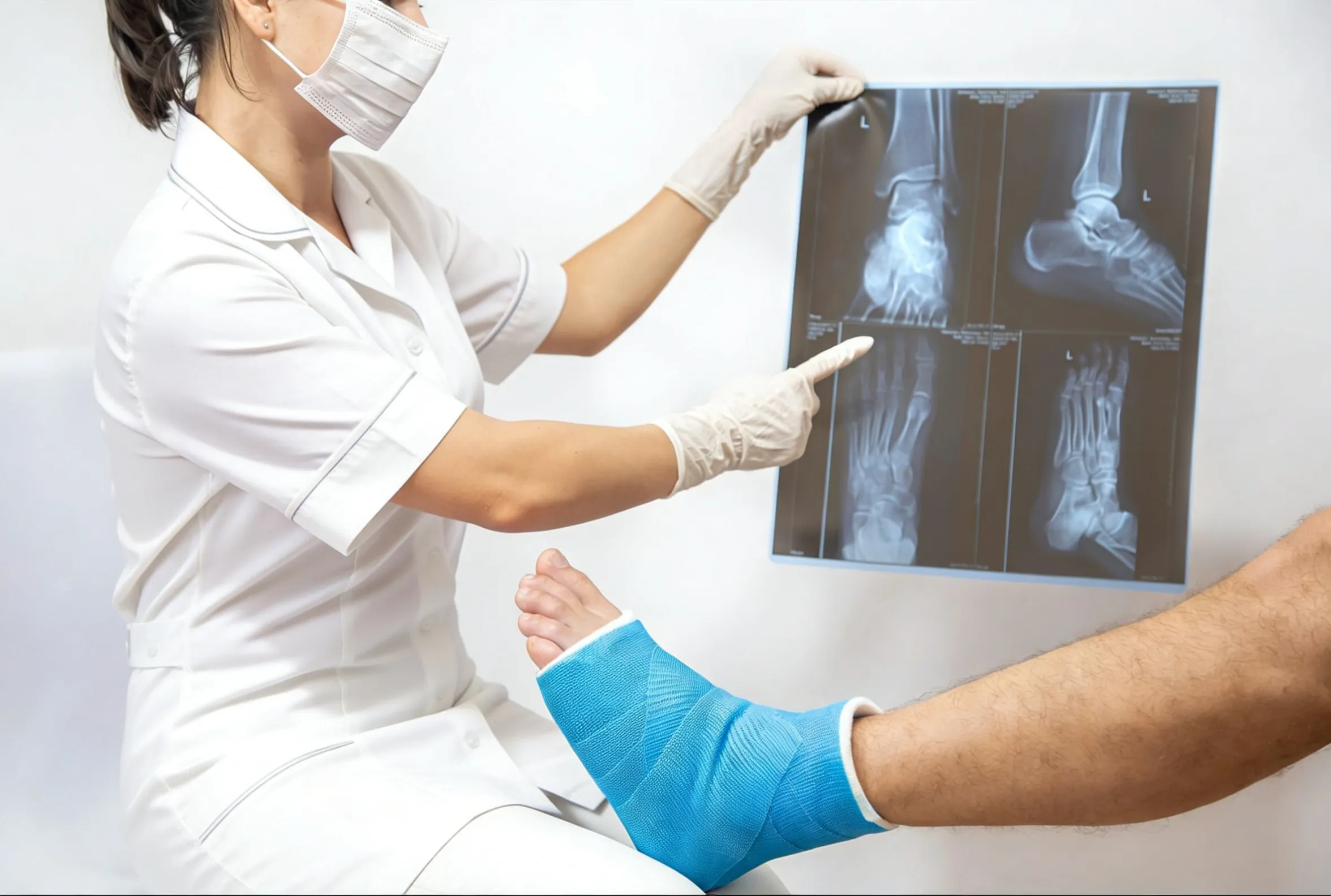
Dr. Leo Chen reviews your on-site digital X-rays and CT if needed, classifies the fracture (Weber, Lauge-Hansen), and selects implants

Stable Fixation, Faster Recovery
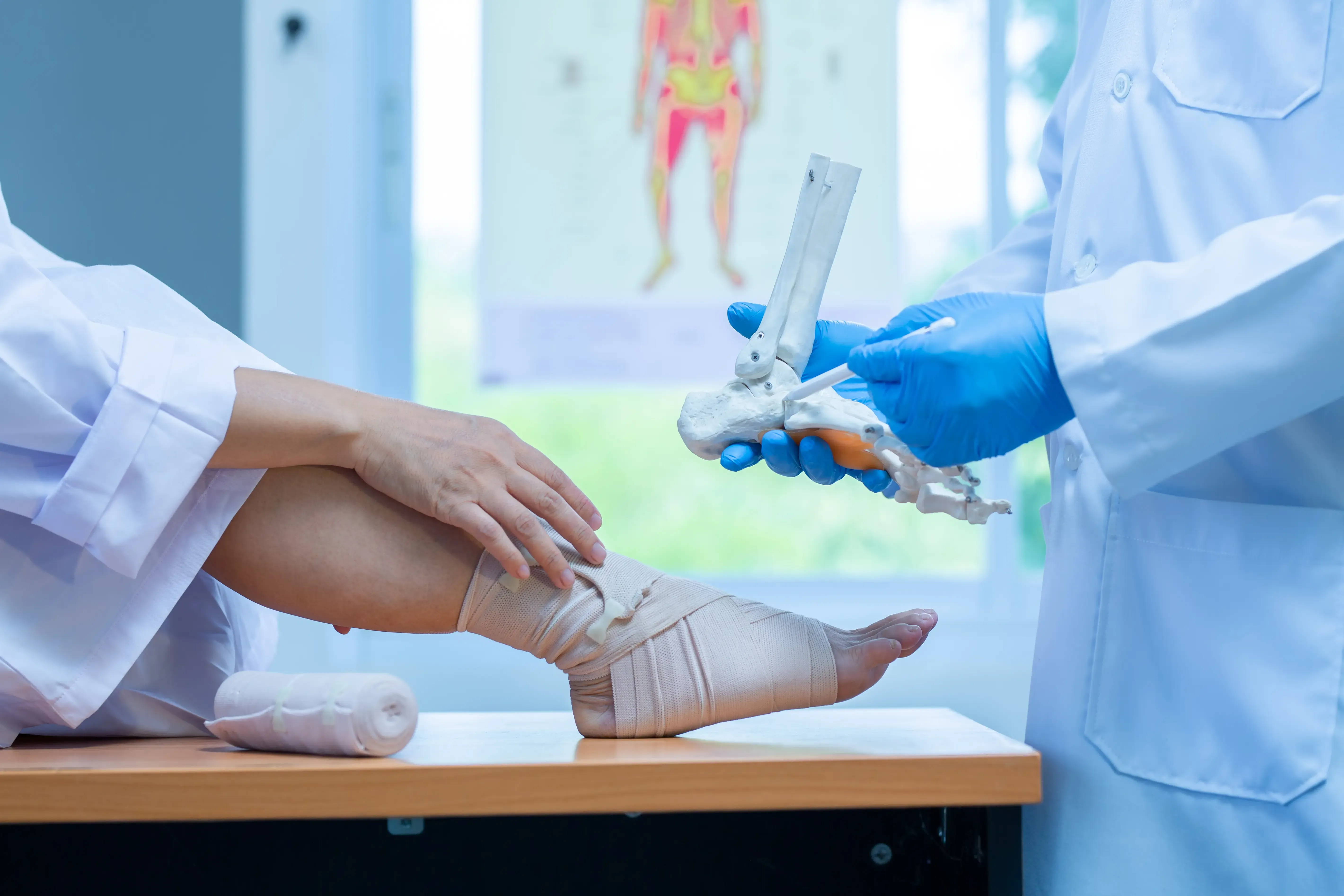
Restoring a stable, aligned joint
A broken ankle can feel deceptively simple at first: swelling, bruising, and pain you hope will settle with rest. But unstable patterns (displaced lateral malleolus, bimalleolar, trimalleolar, syndesmotic disruption, Weber B and Weber C injuries) will not heal correctly in a cast. Bone fragments that sit even a few millimeters off can leave the talus shifted in the mortise, lead to post-traumatic arthritis, chronic ankle pain, and a gait you never fully recover. Many patients also need to return to work, driving, parenting, or active duty quickly.
Ankle fracture surgery (open reduction internal fixation, or ORIF) restores precise anatomic alignment so the joint heals as a stable, congruent mortise. Dr. Leo Chen uses standard AAOS and AO/OTA fixation: lateral malleolus plating with a 1/3 tubular or anatomic distal fibula plate and cortical screws, medial malleolus lag screws or tension band, posterior malleolus screws when fragment size warrants, and syndesmotic screws or suture-button fixation when the tibiofibular joint is unstable. The goal is reliable bone healing, predictable rehab, and a return to walking without limp.
Open Reduction Internal Fixation
Ankle fracture surgery, formally called open reduction and internal fixation (ORIF), is the surgical repair of one or more broken bones around the ankle joint: the fibula (lateral malleolus), tibia (medial malleolus and posterior malleolus, or pilon), and the syndesmosis (the fibrous joint that holds the fibula and tibia together at the ankle). It is indicated when a fracture is displaced, unstable, open, or involves the joint surface in a way that will not heal correctly in a cast or boot.
Most adult ankle fractures are classified two ways. The Weber (Danis-Weber) system describes the level of the fibula fracture relative to the syndesmosis: Weber A (below the syndesmosis, usually stable), Weber B (at the level of the syndesmosis, may be stable or unstable), and Weber C (above the syndesmosis, almost always unstable and surgical). The Lauge-Hansen system describes the mechanism of injury (supination-external rotation, pronation-external rotation, supination-adduction, pronation-abduction) and predicts which structures, including the deltoid ligament and posterior malleolus, are involved.
During surgery, Dr. Leo Chen makes small incisions over the fractured bones. He realigns the fibula anatomically and secures it with a lateral malleolus plate (typically a 1/3 tubular or anatomic distal fibula plate) and cortical and locking screws. A displaced medial malleolus is fixed with partially threaded lag screws or a tension-band wire. A significant posterior malleolus fragment (greater than 25 percent of the joint surface, or one causing talar instability) is fixed with antero-posterior or posterior-to-anterior screws. If intraoperative stress testing shows syndesmotic widening, Dr. Leo Chen places one or two trans-syndesmotic screws or a suture-button (TightRope-style) device to hold the tibia and fibula together while the ligament heals. In trimalleolar fractures, all three malleoli are addressed in one operation. Intraoperative fluoroscopy and on-site digital X-ray confirm anatomic reduction before closure.
The procedure is typically outpatient or short-stay. You go home in a well-padded splint, transition to a boot at 10 to 14 days when sutures come out, and follow a staged rehab plan: non-weight-bearing, then protected weight-bearing in a CAM boot, then full weight-bearing in regular shoes with physical therapy. Most ankle fractures heal within 6 to 12 weeks, with full sport and high-impact activity returning over 4 to 6 months.
What ORIF gives you
2000+ Satisfied patients






Restores the ankle mortise to within 1 to 2 mm of normal anatomy
Lowers risk of post-traumatic arthritis from a misaligned talus
Stable internal fixation allows reliable bone union in 6 to 12 weeks
Protected range-of-motion can often begin at 2 weeks post-op
Most patients walk in a boot by week 6 to 8 and shoes by 10 to 12
Plate-and-screw fixation prevents late displacement during rehab
Treatment options compared
| Treatment | Mechanism | Time | Results | Duration | Downtime | Best For |
|---|---|---|---|---|---|---|
| Ankle Fracture Surgery | ORIF with plate and screws | 60 to 120 min OR | Anatomic, predictable union | Permanent fixation | 6 to 12 weeks | Unstable Weber B/C, bimalleolar, trimalleolar, syndesmotic injuries |
| Casting | Rigid plaster or fiberglass | 30 min application | Heals position as-is | 6 to 10 weeks | 6 to 10 weeks non-weight-bearing | Stable, non-displaced Weber A fractures |
| Walker Boots | Removable CAM boot offloading | Fitted in office | Allows protected motion | 4 to 8 weeks | 4 to 8 weeks partial weight-bearing | Stable distal fibula, isolated lateral malleolus without talar shift |
| Non-Operative Care | Closed reduction, immobilization, PT | Office or ER setting | Variable, depends on stability | Up to 12 weeks | Up to 12 weeks restricted activity | Stable patterns or patients who cannot safely tolerate surgery |

Indications and contraindications
Most patients with displaced or unstable ankle fractures benefit from surgical fixation. Dr. Leo Chen reviews your X-rays, fracture pattern (Weber A/B/C, Lauge-Hansen mechanism), soft tissue condition, and overall health before recommending ORIF. Patients evaluating their options can also read about ankle pain and sibling procedures like wrist fracture surgery in Fort Walton Beach.
If surgery is not the right choice, Dr. Leo Chen will outline a non-operative plan with serial X-rays to confirm the fracture remains stable through healing.
Dr. Leo Chen reviews your on-site digital X-rays and CT if needed, classifies the fracture (Weber, Lauge-Hansen), and selects implants
General or spinal anesthesia with a popliteal block; you are positioned supine with a bump under the operative hip
Dr. Leo Chen reduces the fibula anatomically and applies a 1/3 tubular or anatomic distal fibula plate with cortical and locking screws
Dr. Leo Chen places lag screws for the medial malleolus and antero-posterior screws for any significant posterior malleolus fragment
Dr. Leo Chen stress-tests the syndesmosis under fluoroscopy and, if unstable, places trans-syndesmotic screws or a suture-button before layered closure and splinting
What you should know
Ankle fracture surgery is a well-established procedure with a strong safety record, but every operation carries risk. Dr. Leo Chen reviews each of these with you at consultation. For background on operative versus non-operative criteria, see the AAOS patient education on ankle fractures.
Common, expected effects (most patients): swelling, bruising, and discomfort for 1 to 3 weeks; numbness around the incision (especially over the lateral malleolus where the superficial peroneal nerve sits); stiffness when transitioning out of the boot; temporary weakness in the calf and foot that resolves with physical therapy.
Uncommon (1 to 5 percent): superficial wound healing problems or delayed union or non-union of one fragment, post-traumatic stiffness requiring extra physical therapy, mild chronic swelling.
Rare but serious (less than 1 percent in most series): deep wound infection requiring antibiotics or hardware removal, deep vein thrombosis or pulmonary embolism (prophylaxis is discussed and used when indicated), nerve injury (superficial peroneal or sural nerve), complex regional pain syndrome, malunion requiring revision surgery, post-traumatic arthritis years later (more likely if the joint surface or mortise was significantly disrupted at the time of injury).
Smoking, uncontrolled diabetes, and poor circulation all raise risk. Dr. Leo Chen discusses any modifiable risk factors before scheduling.
Call (850)864-3339 immediately for fever, increasing redness, drainage, calf pain, or shortness of breath after surgery. Patients managing healing alongside other injuries can also explore post-surgery recovery support.
Ankle fracture surgery is almost always covered by health insurance, including commercial plans, Medicare, Medicare Advantage, TRICARE, and most workers' compensation policies. It is considered medically necessary because an unstable fracture left untreated can lead to permanent joint damage.
Your total cost typically includes four components: the surgeon's fee, the facility (ambulatory surgery center or hospital) fee, the anesthesia fee, and the implants. With insurance, you are usually responsible for your deductible, coinsurance, and any co-pay until you reach your out-of-pocket maximum. Many patients with active deductibles pay the bulk of their annual maximum on a single ankle fracture episode, then have minimal cost for follow-up visits and physical therapy that calendar year.
Emerald Coast Ortho works with most major insurers in Okaloosa County and will verify your coverage before surgery is scheduled. Our team confirms in-network status, estimates your out-of-pocket responsibility, and reviews any prior authorization the carrier requires. We also itemize the consultation, surgical, and follow-up portions so you understand what is billed and when.
If you are uninsured, self-pay, or have a high-deductible plan, we can typically quote a bundled surgical estimate that includes the surgeon's fee, basic implants, and routine follow-up. Workers' compensation and motor vehicle injury cases are handled separately and billed through the carrier.
Because every fracture pattern is different (a single lateral malleolus plate is not the same as a trimalleolar with syndesmotic fixation), exact pricing is provided after Dr. Leo Chen has reviewed your imaging and surgical plan. Call (850) 864-3339 to schedule a consultation and to discuss insurance, payment options, and timing.
Fort Walton Beach, FL
Dr. Leo Chen, Diplomate of the American Board of Orthopaedic Surgery
Digital X-ray in office for rapid fracture assessment and follow-up
One surgeon from emergency evaluation through final rehab clearance
Casts, CAM boots, and braces fitted on-site, no separate vendor trips
Surgery follows established AO Foundation plate and screw protocols for reliable, anatomic bone healing.
Experienced handling of workers' compensation, motor vehicle, and active duty fracture cases.
What patients ask most
No. Stable, non-displaced Weber A fractures often heal in a cast or CAM boot. Surgery is recommended when the fracture is displaced, the mortise is unstable, or there is syndesmotic injury or talar shift on X-ray.
Most patients are non-weight-bearing for 2 to 6 weeks, then transition to a CAM boot and protected weight bearing. Walking in shoes typically returns at 8 to 12 weeks. Return to running or sport averages 4 to 6 months.
Dr. Leo Chen typically uses a 1/3 tubular or anatomic distal fibula plate with cortical and locking screws for the lateral malleolus, lag screws or a tension band for the medial malleolus, and either syndesmotic screws or a suture-button for unstable syndesmoses.
Most patients begin protected weight bearing in a CAM boot around 6 weeks after surgery, depending on fracture pattern and healing on X-ray. Full weight bearing in regular shoes is typically 10 to 12 weeks post-op.
Usually no. Hardware is left in place once bone is healed. About 5 to 10 percent of patients elect removal after 9 to 12 months if the plate is prominent or irritating, especially over the lateral malleolus.
Yes. Once you are cleared for protected weight bearing, structured physical therapy restores ankle range of motion, calf strength, balance, and gait. Skipping PT is the most common reason recovery stalls.