Evaluation
Dr. Leo Chen reviews your injury or surgical report and examines the arm to confirm the right sling type.

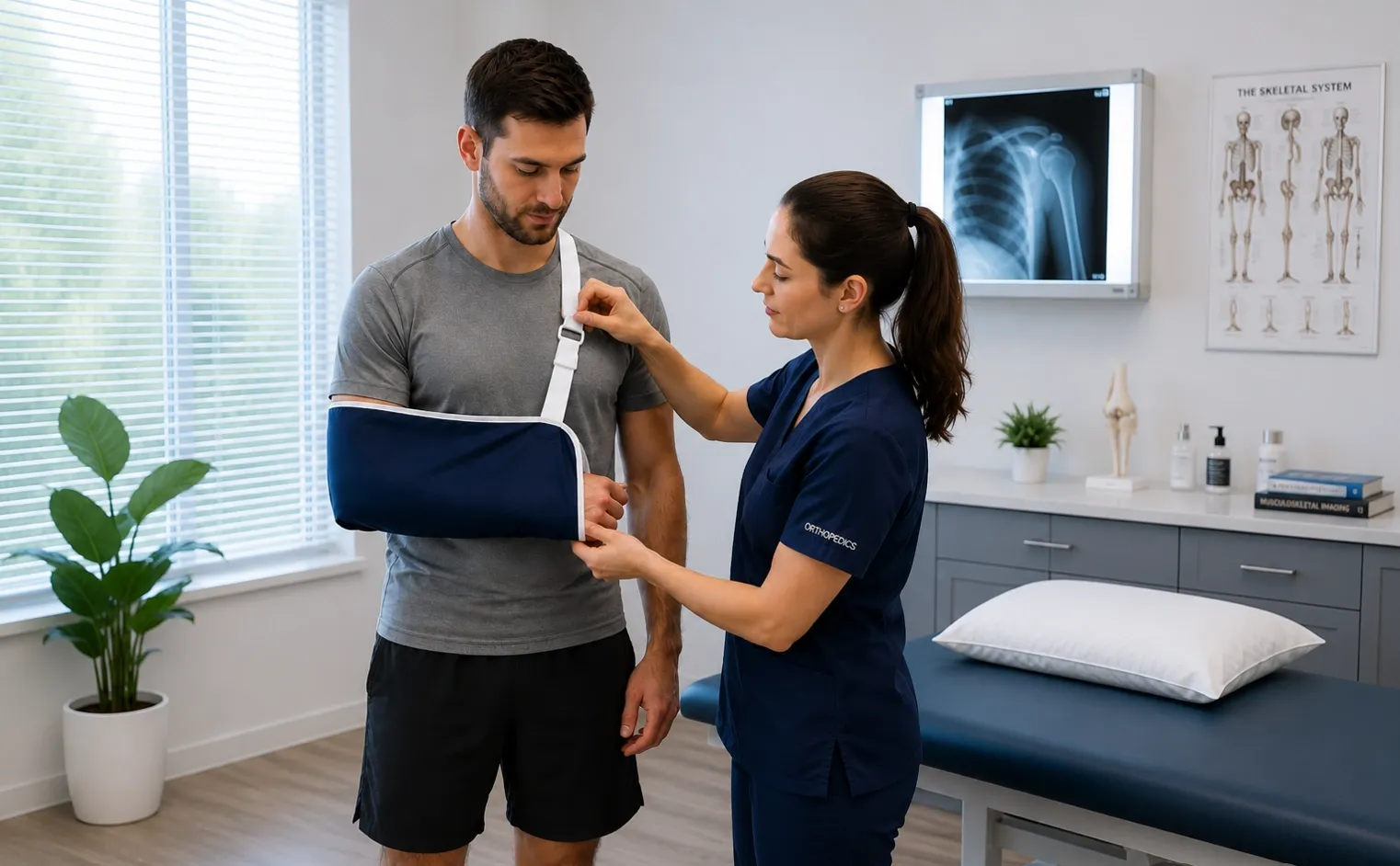
Shoulder and Arm Support
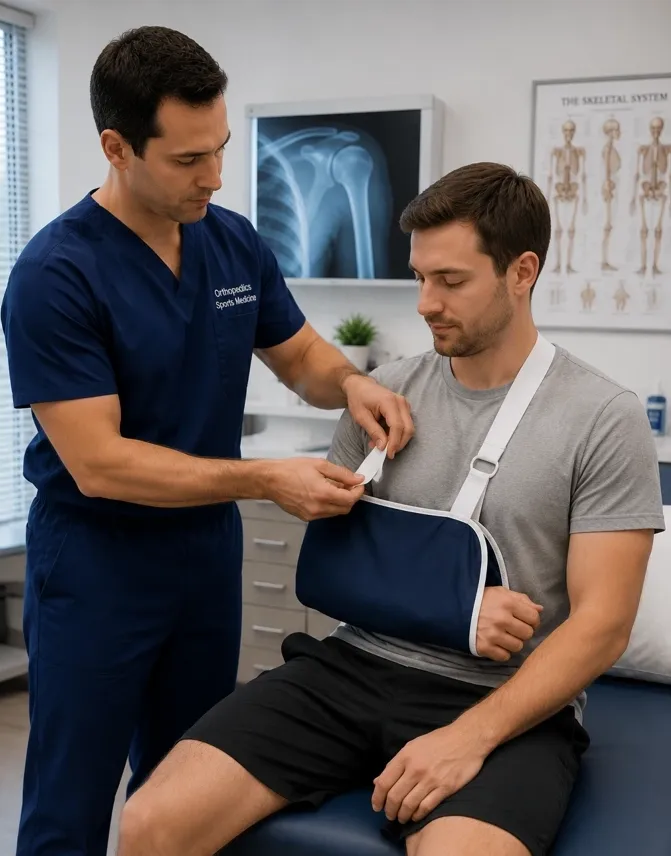
Immobilization that heals
After a shoulder injury, fracture, or rotator cuff repair, your arm needs to rest in a precise position. A poorly fitted sling lets the joint shift, irritates the neck, or rubs the skin raw. Patients often arrive at our office with a drugstore sling that is too loose, too short, or worn incorrectly, and the pain has gotten worse. Without correct support, healing slows, muscles guard, and you risk stiffness that lingers long after the original injury would have settled.
At Emerald Coast Sports Medicine and Orthopaedics, Dr. Leo Chen fits your sling in the same visit as your evaluation or post-op check. We carry standard arm slings, abduction pillows, and ultrasling models so the right device is on your shoulder before you leave. You receive hands-on instruction on how to put it on, sleep in it, and adjust the straps. Same-day digital X-ray confirms the bone or repair is in good position, and we adjust the sling as your protocol allows.
Immobilization device
An arm sling is a soft fabric support that holds your forearm, elbow, and shoulder in a protected position while tissue heals. By cradling the arm against the body, the sling unloads the shoulder joint, reduces pull on healing tendons or repaired tissue, and limits motion that could disrupt fracture alignment or surgical fixation.
Slings come in several designs. A simple arm sling supports the forearm at roughly 90 degrees and is used for distal fractures, soft tissue strains, and many minor injuries. A shoulder immobilizer adds a strap across the body to fully restrict shoulder motion after dislocations or some fractures. An abduction sling, sometimes called an ultrasling, includes a foam pillow that holds the arm slightly away from the body at 15 to 30 degrees. This neutral position takes tension off the supraspinatus and other rotator cuff tendons and is the standard support after rotator cuff repair, labral repair, and shoulder stabilization surgery.
Dr. Leo Chen selects the sling type based on your diagnosis, your surgeon's protocol (when applicable), your body size, and the limb that needs support. You will receive written and verbal instructions on how long to wear it, when to remove it for hygiene and gentle exercises, and signs that should prompt a call back to the office.
Comfort meets compliance
2000+ Satisfied patients






Fitted to your torso and arm so the device actually does its job.
Leave the visit with the sling already on and adjusted.
Sling type matches your diagnosis or surgical protocol exactly.
You practice putting it on and off before you leave the office.
Strap padding and positioning tips to prevent neck and skin irritation.
Compare options
| Treatment | Mechanism | Time | Results | Duration | Downtime | Best For |
|---|---|---|---|---|---|---|
| Arm Sling | External soft support that cradles arm | 10 to 15 min fitting | Immediate protected position | 1 to 6 weeks | Minimal, one-handed activity | Shoulder injuries, post-op shoulder, distal arm injuries |
| Casting | Rigid fiberglass or plaster shell | 20 to 30 min application | Full immobilization of bone | 4 to 8 weeks | Limb fully restricted | Displaced or unstable fractures, post-reduction |
| Non-Operative Care | Activity modification, therapy, medication | Varies by visit | Gradual symptom improvement | Weeks to months | Activity-based only | Many soft tissue injuries and overuse conditions |
Right fit for the right patient
Most patients with a recent shoulder, upper arm, or distal arm injury or surgery benefit from a properly fitted sling. Dr. Leo Chen confirms candidacy after a focused exam and, when needed, same-day digital X-ray.
If a sling is not right for you, Dr. Leo Chen will discuss alternatives such as a different brace, casting, or a non-operative motion program tailored to your diagnosis.
Dr. Leo Chen reviews your injury or surgical report and examines the arm to confirm the right sling type.
On-site digital X-ray confirms bone position or surgical alignment in the same visit.
Dr. Leo Chen chooses a standard sling, immobilizer, or abduction (ultrasling) device from in-office stock.
Straps are sized to your torso, the arm is positioned, and padding is added at the neck and waist.
You practice on and off, receive wear instructions, and schedule a recheck with Dr. Leo Chen.
What to watch for
Arm slings are very safe when fitted and worn correctly, but a few side effects are common, especially in the first week. Most resolve with simple adjustments at your follow-up visit.
Common, usually mild: neck or shoulder soreness from the strap, mild skin irritation where the strap contacts the neck or shoulder, hand or wrist stiffness from limited motion, mild elbow stiffness, and aching in the unsupported shoulder from compensating posture.
Uncommon: pressure sores at strap contact points, tingling or numbness in the hand from a sling worn too tight, swelling in the hand, and headache.
Rare but important: signs of compartment syndrome (severe pain, tense swelling, color change in the fingers), signs of deep vein thrombosis (calf or arm swelling, redness, warmth, sudden shortness of breath), or signs of infection at a surgical site (increasing redness, drainage, fever).
Any of these should promptan immediate call to the office at (850) 864-3339 or, if severe, a visit to the nearest emergency department. Dr. Leo Chen reviews these warning signs at every fitting so you know exactly when to call.
Arm slings are durable medical equipment (DME) and are typically billed through your health insurance when dispensed in connection with a covered office visit, fracture care, or post-surgical recovery. Your out-of-pocket cost depends on your deductible, coinsurance, DME benefit, and whether your plan considers Emerald Coast Sports Medicine and Orthopaedics an in-network provider.
What is usually billed:
What to discuss at your visit: bring your insurance card, ID, and any surgical report or referral. Our front office team will verify benefits, explain what your plan typically covers for DME, and outline any expected out-of-pocket portion before the sling is dispensed. Self-pay pricing is available for patients without coverage and is quoted up front.
Because every plan and every injury is different, the most accurate pricing comes from a quick phone call. Please contact (850) 864-3339 with your insurance details and we will give you a clear estimate before you arrive.
Fort Walton Beach, FL
Sling fitted by Dr. Leo Chen, not handed off to an outside vendor.
Confirms bone position and surgical alignment in the same visit.
Standard, immobilizer, and abduction slings all on the shelf.
Straps and position revisited at every recheck as healing progresses.
Slings are prescribed as part of a broader treatment plan that may include casting, bracing, injections, or surgery - all available at the same Fort Walton Beach practice.
Slings are billable as durable medical equipment under Medicare, Tricare, and most commercial plans. We handle the paperwork so you leave with your sling the same day.
What patients ask most
Most patients wear a sling for 1 to 6 weeks. The exact timeline depends on your diagnosis or surgical protocol. Dr. Leo Chen sets a wear schedule and adjusts it at each follow-up visit.
Slide your forearm into the pouch with the elbow tucked into the corner. Loop the strap behind your neck and clip it in front. Pad the neck where the strap rests, and keep the wrist supported, not dangling.
Driving with a sling is not recommended. One-handed steering, delayed reaction time, and pain medication can all impair safe driving. Wait until Dr. Leo Chen clears you to drive at a follow-up visit.
Yes, and most protocols require it for the first 2 to 6 weeks. Sleep on your back or your uninjured side, prop the arm with pillows for comfort, and keep the strap loose enough to avoid neck pressure.
Usually yes, after the first few days and per Dr. Leo Chen's instructions. Remove the sling carefully, keep the arm close to your body, and let it rest at your side. Replace the sling as soon as you are dry.
Add the included neck pad or a soft cloth where the strap rests, and check that the elbow is fully seated in the sling. If irritation continues, call (850) 864-3339 for a quick adjustment visit.